An interactive networked performance using a haptic wearable bodysuit to communicate experiences of difference and queerness.
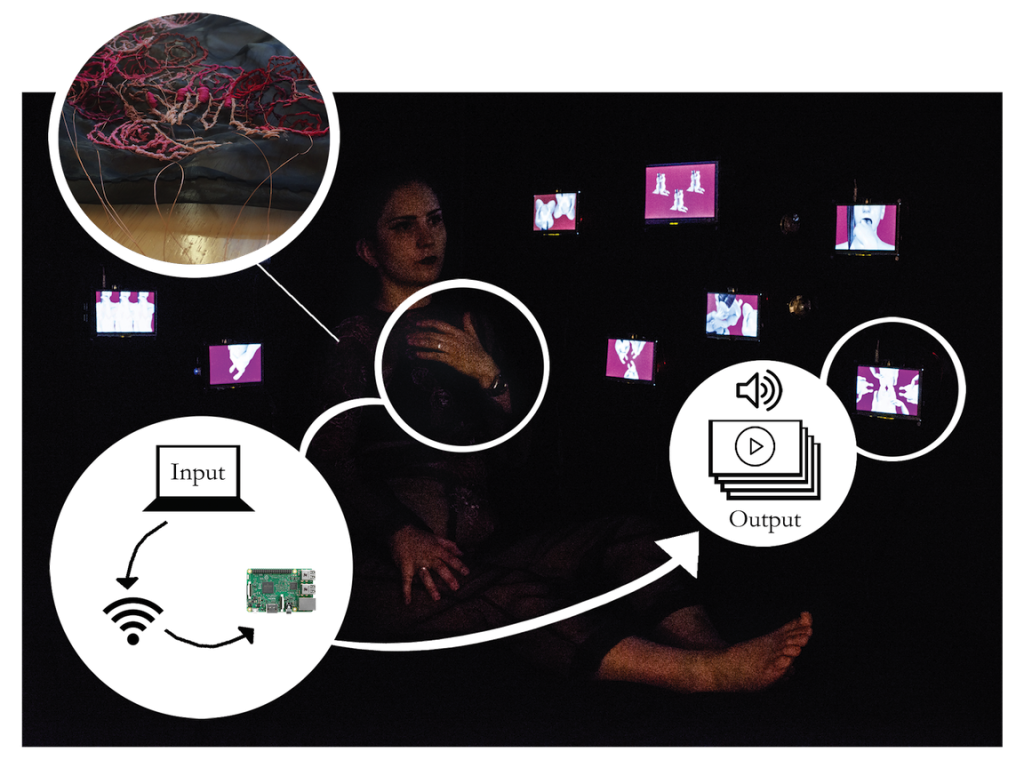
Assembling Desire (2016) is controlled by a wearable suit, made of black chiffon and worn directly against my skin. The suit has a hand-embroidered pattern delineating the area which is wired for haptic interaction with fine gauge copper wire. This wire is connected to the various pins of a capacitive touch sensor, which is connected to an Arduino. By adjusting the capacitance sensitivity thresholds of the sensor’s Arduino library, I was able to create a wearable using thin fabric that is sensitive enough to relay external touch data in real time, without allowing data from my body inside the suit to interfere.

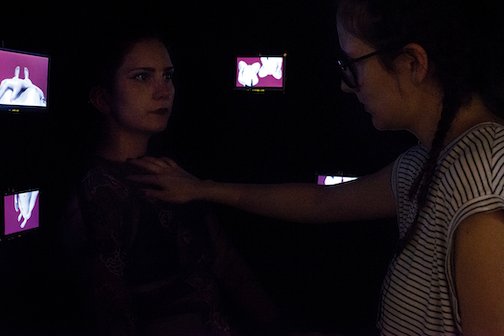
Areas of the suit are mapped to individual pins on the chip, and data about which section of the suit is being touched is fed through a Processing sketch and broadcast via Open Sound Control and a closed wireless network to nine Raspberry Pis with attached screens, each between 5 and 7 inches wide. The small screens are installed on either side of a corner area, and grouped around me while I sit on an elevated shelf in the middle. Depending upon the data the Raspberry Pis receive, the openFrameworks programs running on them algorithmically modify the order, speed, and volume of the visuals and sound in real time in response to the participant’s touch.
The visuals, spanning digital video, still images, and 3D modeled self-portraits, juxtapose photographic and illustrative media to draw tension between the implied ‘reality’ of the photographic images and the perceived lack thereof in the illustrative, avatar-based works. The performance is a real-time exercise in consent between myself and the participant, and I guide the participant through their interaction with me and the haptic suit, checking in periodically and exchanging with them throughout their experience of the piece. Assembling Desire unpacks the development of lesbian desire through visual media and symbolism, questioning and reconfiguring the erasure of these symbols in broader visual culture.

Further Information
- The source code for the Processing (Java), openFrameworks (C++) and Arduino programs used in Assembling Desire are available on my GitHub.